
The limits of my medium are the limits of my message
Humanity is defined by its technology. As far back as the earliest cave paintings and the invention of writing, communications technologies have been central to our evolution as a species. Each communications technology represents a medium through which ideas may be transmitted, but not all mediums are created equal.
“The medium is the message”
— Marshall McLuhan
Every medium exerts an influence based on what it affords. Whatever is convenient, accessible, and possible to express within a given medium determines not just the form of information transmitted, but the understanding, discourse, and worldview of its users. This means not all mediums are created equal.
The written word, for example, is nuanced, opinionated, permanent, and serious. It encourages rationality, vigilance, and reasoning. It demands to be understand through syntax, critical thought, and active engagement.
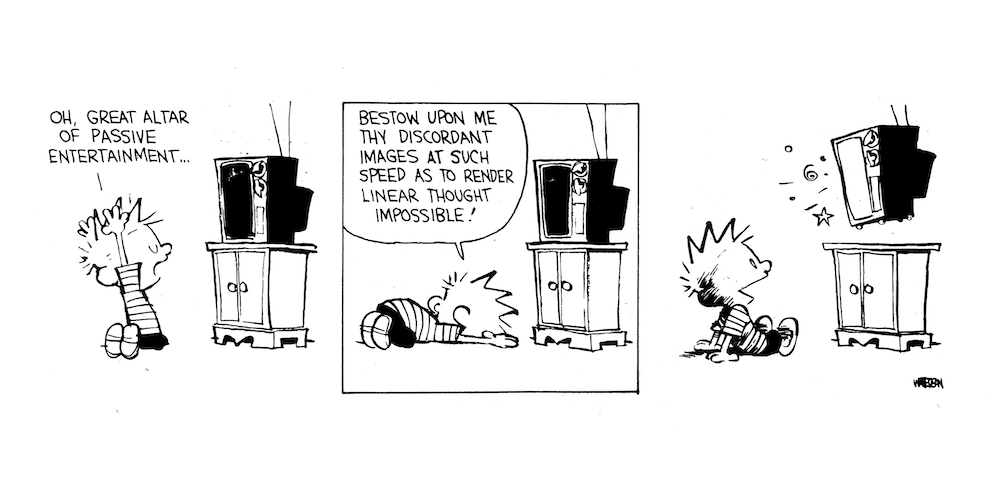
Television, on the other hand, is fleeting, fragmented, decontextualized, and unserious. It encourages simplicity, shallowness, and entertainment. It demands attention through a continuous stream of visual stimulation without requiring active participation or thought.
Not all mediums are transferable. The Odyssey is not the same in the oral tradition as it is in print, or on screen. A presidential debate on the radio is not the same as on TV. What can be expressed in one medium, may be lost in translation to another.
Not all mediums express ideas in the same way. Music can convey things that the visual arts cannot. There are things which architecture can convey which the dance cannot. The more mediums one has at their disposal, the greater their capacity for understanding and expression. This is never more true than with the ultimate human technology—language.
The richer one’s vocabulary, and better their grasp of grammar, the more they have at their disposal to make sense of and express their lived experience. Consider emotional vocabulary: it’s difficult—if not impossible—to identify, make sense of, and articulate feelings without the words for those feelings. Sometimes the words we lack exist unbeknownst to us. Other times, the language itself falls short.
“The limits of my language means the limits of my world”
— Ludwig Wittgenstein, Tractatus Logico-Philosophicus Proposition 5.6
Contrast English, a language dominated by nouns, with Potawatomi, a language dominated by verbs. Most words in Potawatomi are animate and alive (e.g., rocks, mountains, rivers, songs, cities), and what few inanimate words there are often belong to the man-made world (e.g., machines, vehicles).
In English, “tree” is a static, objective, inanimate thing. In Potawatomi, the word for “tree” is closer to the act of being a tree. A tree is a alive, a person, a neighbor, a process. Indigenous ways of knowing understand the natural world to be an architecture of connections and relationships, conceptualized by change, rhythm, wisdom, behavior, and context. Their language is a reflection of that worldview, and their worldview reflects their language.
The universe is a communion of subjects rather than a collection of objects”
— Brian Swimme and Thomas Berry, The Universe Story
People innately see the natural world as a collection of living things, exhibited by how children refer to plants and animals as people too. Western languages like English dehumanize the natural world, instead regarding it as “resources.” With language that reduces another to something less than human, something not worthy of human treatment, which enables their disregard and exploitation. If one sees a living being—like a tree—as a “he” or “her,” they’d be more likely to think twice about taking his or her life.
Our languages, like our technologies, are not unbiased. They actively determine our thoughts, modes of discourse, and understanding of the world. In this way, what matters is not so much what we hear, think, or say, but how.
Sources
- Brown, Brené. Atlas of the Heart: Mapping Meaningful Connection and the Language of Human Experience. Diversified Publishing, 2022.
- Hassan, Robert. Analog. MIT Press, 2023.
- Kimmerer, Robin Wall. Braiding Sweetgrass: Indigenous Wisdom, Scientific Knowledge and the Teachings of Plants. Tantor Media, 2016.
- Postman, Neil. Amusing Ourselves to Death. William Heinemann, 1986.